The Strange Case of Dr Jekyll and Mr Hyde
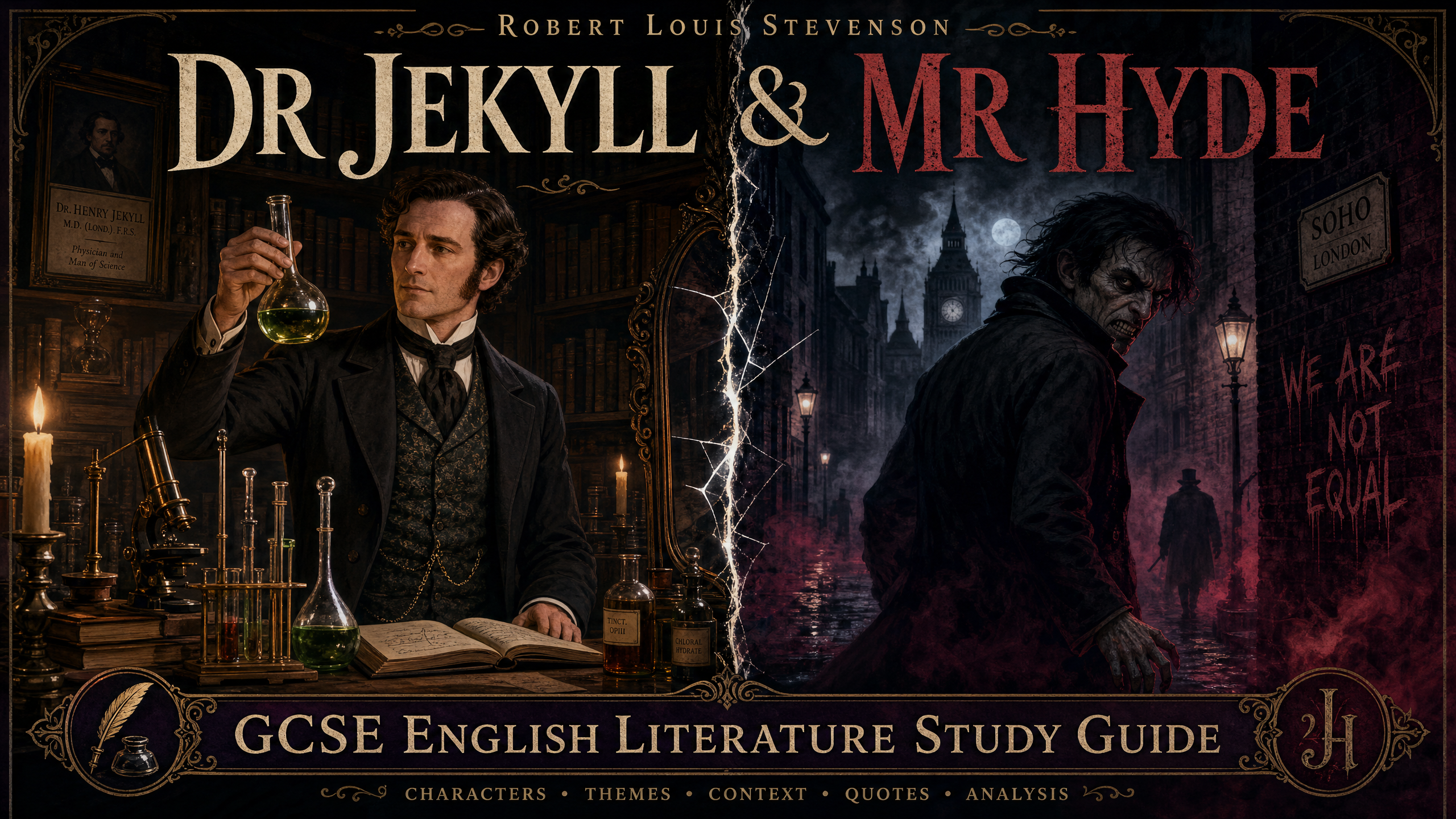
The Strange Case of Dr Jekyll and Mr Hyde is a gripping psychological thriller that exposes the dark underbelly of Victorian respectability. Studying this text rewards you with rich opportunities to analyze complex narrative structures, potent Gothic imagery, and profound themes of duality and scientific hubris that still resonate today.
Study Notes
Overview
Robert Louis Stevenson's The Strange Case of Dr Jekyll and Mr Hyde (1886) is a seminal Gothic novella that explores the profound psychological and moral tensions of the Victorian era. At its core, it is an investigation into the duality of human nature—the terrifying idea that respectability and depravity can coexist within the same individual. For GCSE Literature candidates, this text offers rich opportunities to demonstrate critical analysis. Examiners are looking for a nuanced understanding of Stevenson's methods: his use of an epistolary and layered narrative structure to build suspense, his atmospheric depiction of a fog-bound, divided London, and his potent language choices that reflect Victorian anxieties about scientific hubris, Darwinian evolution, and moral degeneration. To achieve the highest marks, candidates must avoid simply retelling the plot or treating Jekyll and Hyde as a basic 'good vs evil' binary. Instead, successful responses will embed context seamlessly into the analysis of language and form, arguing a clear thesis about how Stevenson constructs his complex critique of Victorian hypocrisy.
Podcast Episode
Listen to our comprehensive 10-minute audio guide covering core concepts, exam tips, and a quick-fire recall quiz:
Plot/Content Overview
- Chapter 1: Story of the Door – Mr Utterson and his cousin Richard Enfield walk past a neglected door. Enfield recounts a story of a sinister man named Hyde who trampled a young girl and then paid off her family with a cheque signed by the respectable Dr Jekyll.
- Chapter 2: Search for Mr Hyde – Utterson, Jekyll's lawyer, examines Jekyll's will, which leaves everything to Hyde. Deeply concerned, Utterson stakes out the door, eventually meeting the repulsive Hyde. Utterson then visits Dr Lanyon, who reveals he has fallen out with Jekyll over "unscientific balderdash."
- Chapter 3: Dr Jekyll was Quite at Ease – Utterson attends a dinner party at Jekyll's house. When Utterson brings up the will and Hyde, Jekyll grows pale and insists he can be rid of Hyde whenever he chooses.
- Chapter 4: The Carew Murder Case – Nearly a year later, an elderly MP, Sir Danvers Carew, is brutally beaten to death by Hyde. A broken cane belonging to Jekyll is found at the scene. Utterson leads the police to Hyde's Soho rooms, but Hyde has vanished.
- Chapter 5: Incident of the Letter – Utterson visits a sickly Jekyll, who swears he is done with Hyde and produces a letter supposedly from Hyde. Utterson's clerk, Guest, notices the handwriting is almost identical to Jekyll's.
- Chapter 6: Remarkable Incident of Dr Lanyon – Jekyll briefly returns to his old sociable self, but suddenly retreats into seclusion. Utterson visits Lanyon, who is physically devastated and dying from a terrible shock. Lanyon leaves Utterson a letter, not to be opened until Jekyll's death or disappearance.
- Chapter 7: Incident at the Window – Utterson and Enfield see Jekyll at his window. They chat briefly before a look of "abject terror and despair" crosses Jekyll's face, and he slams the window shut, horrifying the two men.
- Chapter 8: The Last Night – Poole, Jekyll's butler, fetches Utterson, terrified by strange sounds from the laboratory. They break down the door and find Hyde's twitching body, dead by suicide, but no sign of Jekyll. They find a new will leaving everything to Utterson, and a confession from Jekyll.
- Chapter 9: Dr Lanyon's Narrative – We read Lanyon's letter, which reveals the horrific truth he witnessed: Hyde drinking a potion and transforming into Dr Jekyll before his eyes. The shock of this unnatural subversion of science is what killed Lanyon.
- Chapter 10: Henry Jekyll's Full Statement of the Case – Jekyll's own confession. He explains his lifelong struggle with his darker desires, his creation of the potion to separate his two sides, the initial thrill of being Hyde, and the tragic loss of control as Hyde began to take over his body spontaneously, leading to his inevitable doom.
Themes
Theme 1: Duality of Human Nature
The central philosophical premise of the novella is that human beings are not single, unified entities, but are fundamentally divided between civilized, moral impulses and primitive, dark desires. Stevenson suggests this duality is inescapable. Crucially for exam analysis, Jekyll's tragedy is not just that he has an evil side, but that he attempts to separate and isolate it, rather than integrating and accepting it. The text critiques the strict Victorian moral code that forced men to hide their true natures behind a veneer of respectability.
Key Quotes:
- "man is not truly one, but truly two." (Chapter 10) - Jekyll's definitive statement. The repetition of "truly" emphasizes that this division is fundamental and inherent to the human condition, not an aberration.
- "these polar twins should be continuously struggling." (Chapter 10) - The metaphor of "polar twins" highlights the inseparable yet diametrically opposed nature of good and evil within the self.
- "I was slowly losing hold of my original and better self, and becoming slowly incorporated with my second and worse." (Chapter 10) - Demonstrates the terrifying loss of control; the verbs "losing hold" and "incorporated" show the insidious, consuming power of the repressed darker self.
Theme 2: Science, Hubris, and the Unknown
Stevenson explores the terrifying potential of scientific advancement when untethered from morality. Jekyll's experiment is an act of extreme hubris—he plays God by attempting to alter the fundamental nature of humanity. This theme taps directly into Victorian anxieties surrounding Charles Darwin's theory of evolution (which suggested a link between humans and animals) and the fear of "degeneration" (the idea that civilized man could regress to a primitive state).
Key Quotes:
- "unscientific balderdash" (Chapter 2) - Lanyon's dismissal of Jekyll's work. It highlights the conflict between rational, orthodox Victorian science (Lanyon) and dangerous, transcendental mysticism (Jekyll).
- "added one of the powders... the mixture, which was at first of a reddish hue, began, in proportion as the crystals melted, to brighten in colour" (Chapter 9) - The detailed, procedural description of the chemical reaction contrasts sharply with the supernatural, horrific outcome, grounding the horror in tangible science.
- "the trembling immateriality, the mist-like transience, of this seemingly so solid body in which we walk attired." (Chapter 10) - Jekyll's realization that physical form is fragile and mutable; a profound challenge to the solid certainties of Victorian materialism.
Theme 3: Reputation, Secrecy, and Repression
Victorian society placed immense value on outward respectability. The novella shows how this obsession with reputation breeds secrecy, hypocrisy, and ultimately, monstrous behavior. Characters constantly suppress their emotions, hide their actions, and avoid asking difficult questions to protect their social standing. Hyde thrives precisely because the society around him is so committed to looking the other way.
Key Quotes:
- "the last good influence in the lives of downgoing men" (Chapter 1) - Describes Utterson. He is tolerant, but his very tolerance and discretion allow secrets to fester.
- "I make it a rule of mine: the more it looks like Queer Street, the less I ask." (Chapter 1) - Enfield's pragmatic approach to scandal. This deliberate willful ignorance is a coping mechanism for Victorian gentlemen, allowing hypocrisy to flourish.
- "If I am the chief of sinners, I am the chief of sufferers also." (Chapter 6) - Jekyll's melodramatic assertion highlights the intense psychological toll of maintaining his secret and the agonizing burden of his repressed guilt.
Character Analysis
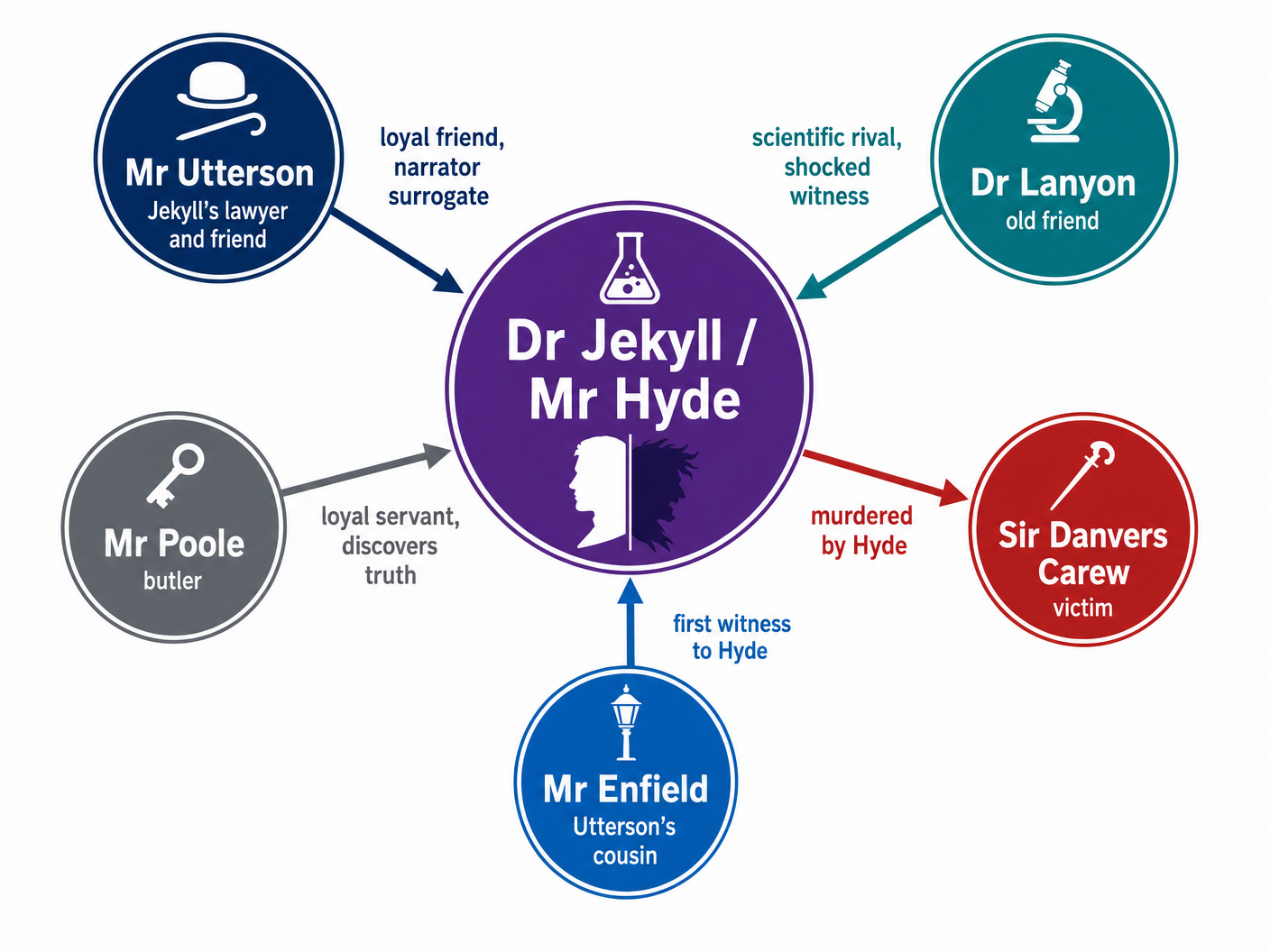
Dr Henry Jekyll
Role: The protagonist and tragic figure; a respected Victorian scientist whose desire to indulge his darker impulses leads to his destruction.
Key Traits: Ambitious, hypocritical, tormented, initially arrogant but ultimately desperate.
Character Arc: Moves from confident scientific hubris and the thrill of liberation to terrifying loss of control, profound isolation, and ultimate self-destruction as Hyde consumes him.
Essential Quotes:
- "a large, well-made, smooth-faced man of fifty, with something of a slyish cast perhaps, but every mark of capacity and kindness"
- "My devil had been long caged, he came out roaring."
- "I bring the life of that unhappy Henry Jekyll to an end."
Mr Edward Hyde
Role: The physical embodiment of Jekyll's repressed, primitive, and amoral desires.
Key Traits: Violent, animalistic, remorseless, physically repulsive, energetic.
Character Arc: Begins as a smaller, younger, controlled manifestation of Jekyll's dark side, but grows in stature and power, eventually dominating and destroying his creator.
Essential Quotes:
- "pale and dwarfish, he gave an impression of deformity without any nameable malformation"
- "with ape-like fury, he was trampling his victim under foot"
- "he had a displeasing smile, he had borne himself to the lawyer with a sort of murderous mixture of timidity and boldness"
Mr Gabriel John Utterson
Role: The rational, respectable lawyer through whose perspective the reader experiences most of the mystery.
Key Traits: Loyal, methodical, repressed, curious, a bastion of Victorian orthodoxy.
Character Arc: Utterson remains fundamentally unchanged, serving as a stable anchor. His journey is one of gradual, horrifying discovery as his rational worldview is dismantled by the truth of Jekyll's dual nature.
Essential Quotes:
- "a man of a rugged countenance that was never lighted by a smile; cold, scanty and embarrassed in discourse; backward in sentiment; lean, long, dusty, dreary and yet somehow lovable."
- "If he be Mr Hyde... I shall be Mr Seek."
- "God forgive us, God forgive us" (Upon seeing Jekyll's transformation at the window)
Writer's Methods
1. Narrative Structure and Perspective:
Stevenson employs an epistolary and fragmented narrative. By filtering the story primarily through the limited, rational perspective of Utterson, Stevenson creates a detective mystery. We are kept in the dark, experiencing the mounting dread and confusion of the Victorian establishment. The delayed revelation—withholding the truth until Lanyon's and Jekyll's final documents—forces the reader to piece the puzzle together, heightening the suspense and mirroring the theme of hidden truths.
2. Setting and Pathetic Fallacy:
London is presented as a divided city, reflecting the duality of the protagonist. Jekyll's respectable house with its "great air of wealth" contrasts sharply with the "blistered and distained" door of the laboratory in a dingy Soho street. Stevenson masterfully uses pathetic fallacy, deploying the thick, choking Victorian fog ("a great chocolate-coloured pall lowered over heaven") to obscure vision, symbolize moral confusion, and provide a cloak for Hyde's crimes.
3. Language and Imagery:
Stevenson uses vivid, often grotesque imagery to describe Hyde, relying heavily on zoomorphism (animalistic descriptions) such as "ape-like fury" and "hissing intake of the breath." This language taps into Darwinian anxieties. Furthermore, he uses binary oppositions (light/dark, inside/outside, respectable/repulsive) to constantly reinforce the theme of duality at a linguistic level. The inability of characters to describe Hyde accurately ("something wrong with his appearance") highlights that he represents an evil that defies rational Victorian language.
Context
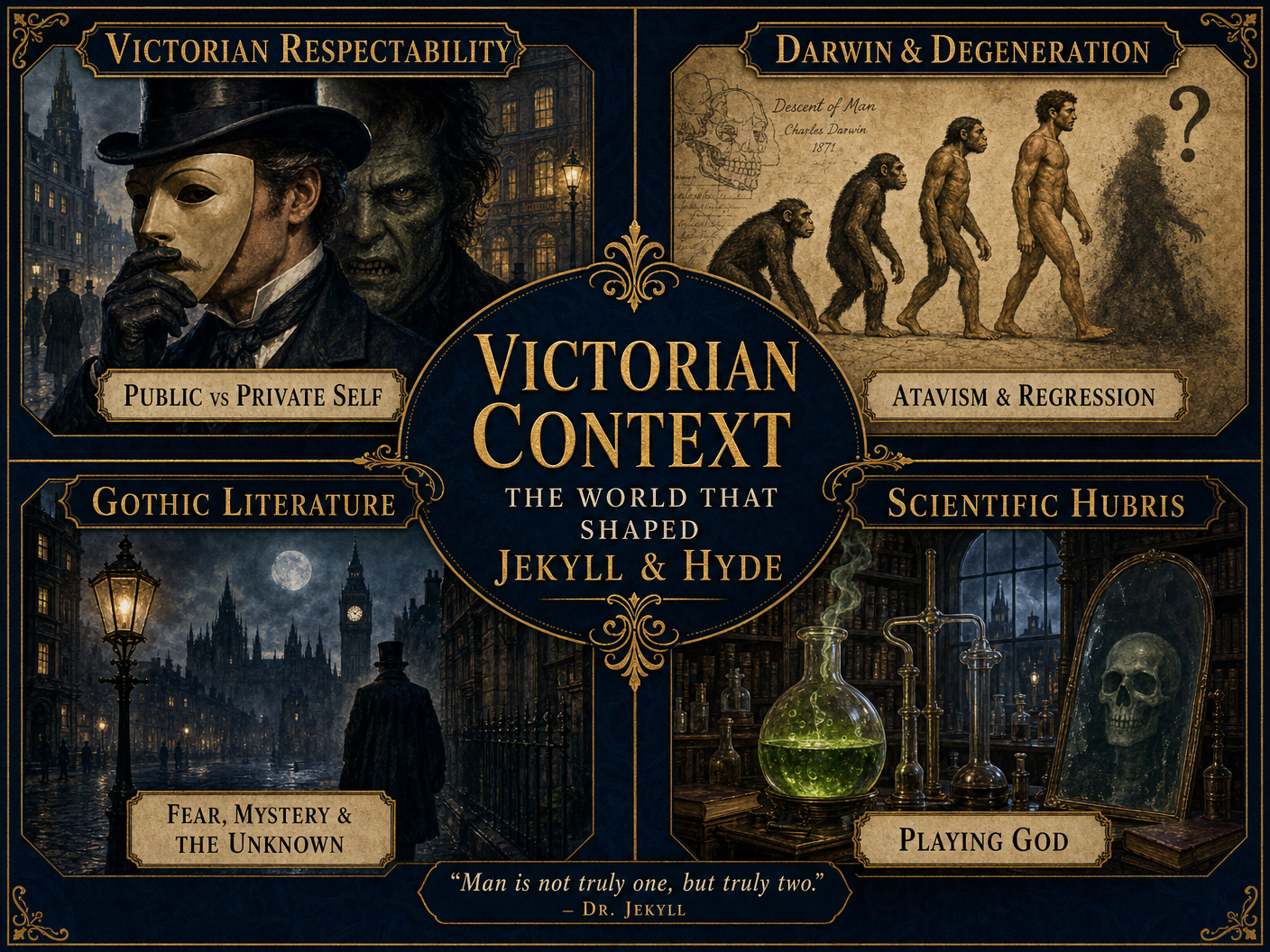
To achieve high marks in AO3, candidates must weave the following contextual factors into their analysis:
- Victorian Respectability and Hypocrisy: The strict moral codes of the 19th century demanded absolute propriety in public. However, this often masked private vices (gambling, prostitution, opium use). Jekyll's creation of Hyde is a direct response to this oppressive need to maintain a flawless public facade while satisfying private desires.
- Darwinism and Degeneration Theory: Charles Darwin's On the Origin of Species (1859) shocked Victorian society by suggesting humans evolved from apes. This led to 'degeneration theory'—the fear that civilized society could regress to a primitive, animalistic state. Hyde, with his "ape-like" fury and "troglodytic" appearance, is the literal embodiment of this evolutionary nightmare.
- The Gothic Tradition: Stevenson utilizes established Gothic conventions—secrecy, isolated settings, the supernatural, and the double (the doppelgänger)—but innovates by placing the horror not in a distant ruined castle, but in the familiar, contemporary streets of London, and grounding the transformation in science rather than magic.
- Scientific Hubris: The Victorian era was a time of rapid scientific and medical advancement. Jekyll's experiments reflect contemporary anxieties about scientists "playing God" and interfering with the natural order, suggesting that some boundaries should not be crossed.
Visual Resources
2 diagrams and illustrations
Interactive Diagrams
1 interactive diagram to visualise key concepts
Conceptual Flow Outline
The Tragic Arc of Dr Henry Jekyll
Worked Examples
2 detailed examples with solutions and examiner commentary
Practice Questions
Test your understanding — click to reveal model answers
Starting with this extract (from Chapter 10, 'I was slowly losing hold...'), explore how Stevenson presents the struggle between good and evil in the novel. (30 marks + 4 AO4)
Hint: Don't just say good fights evil. Discuss how the 'evil' is actually a repressed part of the 'good', and how the struggle is internal rather than external.
Explore how Stevenson presents the character of Mr Utterson as a typical Victorian gentleman. (30 marks + 4 AO4)
Hint: Look at Utterson's opening description in Chapter 1. How does his repression and desire to avoid scandal actually allow Hyde to get away with his crimes for so long?
How does Stevenson use the theme of science to create tension and fear? (30 marks + 4 AO4)
Hint: Contrast Jekyll's 'transcendental' science with Lanyon's rational science. Why does the truth literally kill Lanyon?
Explore the significance of the doors and windows in the novella. (30 marks + 4 AO4)
Hint: Think about what doors hide and what windows reveal. They are boundaries between the public (respectable) and the private (shameful).